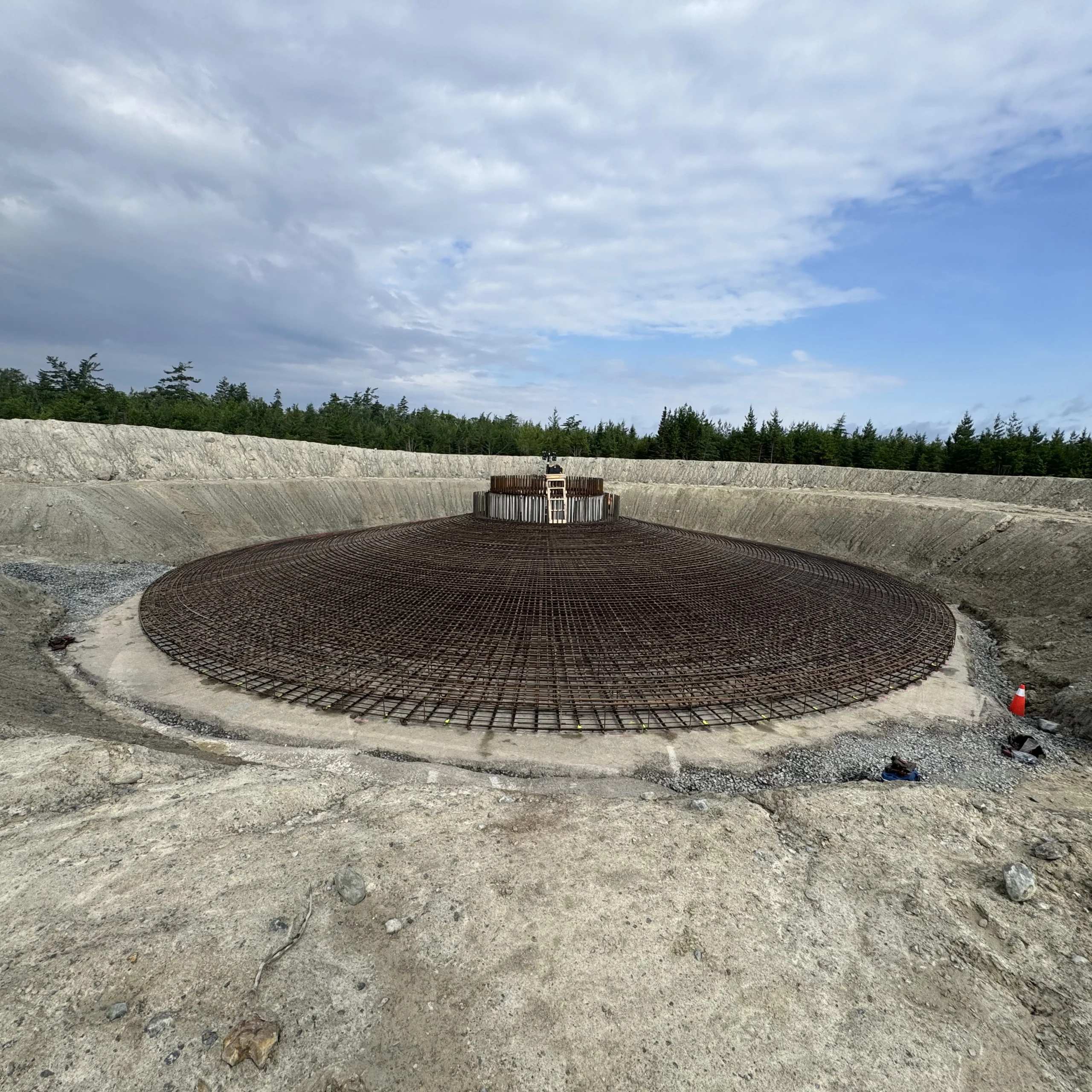
AGF teams are currently working on three major wind projects across Canada: the Saint-Paul-de-Montminy Wind Farm and the Forêt Domaniale Wind Farm, both located in the Montmagny region of Quebec, as well as the Mersey River Wind Farm in Queens County, Nova Scotia.
The wind sector is nothing new for AGF. Over the years, our teams have contributed to several wind projects across Canada. This time, with three major projects underway at once, careful planning is essential to coordinate production and meet the needs of each jobsite.
The Complexity of Wind Turbine Foundations
Wind turbines are impressive once installed, but much of the work actually takes place underground, in the foundations that support these massive structures. These foundations contain a significant amount of rebar, including radius rebar that must follow the circular shape of the foundation. In some cases, the rebar also has to follow a slope, which adds to the complexity of the installation.
💡 What is radius rebar?
Radius rebar is curved continuously along its length to follow a specific radius, rather than remaining straight or being bent only at specific points. This continuous curvature requires more time and precision to produce than conventional rebar.
Producing all the rebar required for the three projects requires careful planning. Several measures have been put in place to support production and manage the high volume.
Staying Ahead of Production
AGF already has the equipment required to produce radius rebar, but with three projects underway at the same time, additional machines were ordered to increase production capacity. Radius rebar and other more complex components, including stirrups and steel rebar chairs, are produced two to three months ahead of delivery.
“With the volume we have to produce, we can’t wait until the last minute. We need to stay ahead and spread the production workload over time,” says Naomi Meunier, Project Manager.
Well-Planned Logistics
With so much rebar prepared in advance, dedicated areas have been set up in the yard at the Longueuil shop specifically for the wind projects, making it easier to sort and identify the material for each jobsite. Checklists are used to track production and plan trailer loading as deliveries progress.
The Strength of the AGF Network
To support production at the Longueuil shop, other AGF business units are also contributing. Certain components, including stirrups and steel rebar chairs, are produced by the Ottawa, Trois-Rivières and Kitchener teams and then shipped to Longueuil. This distribution of work makes it possible to draw on the production capacity of several teams while keeping material management centralized in one location.
Coordination from the Office to the Jobsite
To keep everything moving at the right pace, project managers, production teams and jobsite crews work closely together. Good communication between everyone involved helps the teams keep track of progress at each jobsite and manage the work efficiently.
There is definitely a lot of teamwork behind these three projects. Congratulations to all the teams contributing to their successful completion!